
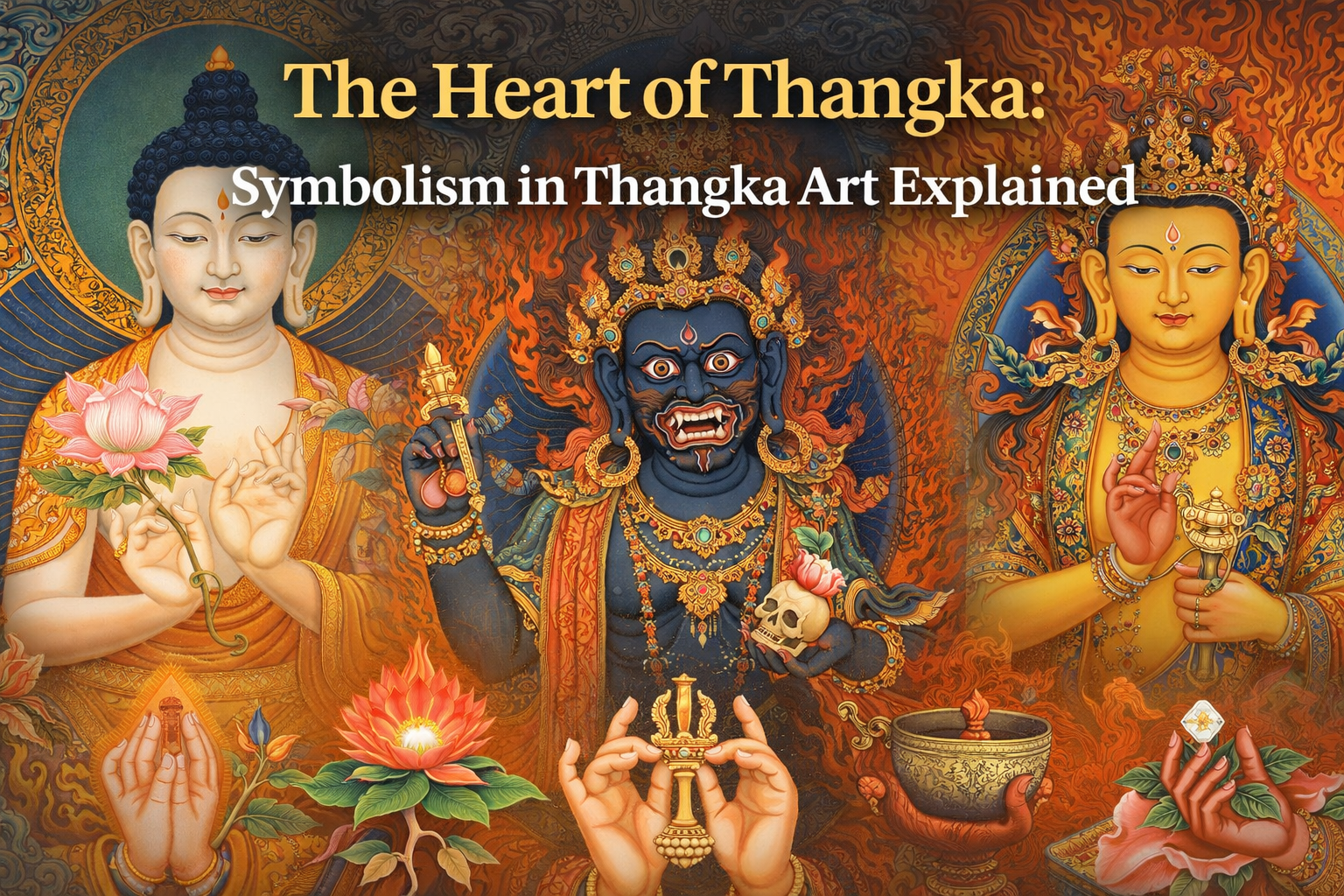
A thangka is never silent. Even when viewed in complete stillness, it speaks, through gesture, symbol, expression, and form. Unlike ordinary paintings, a thangka does not exist to decorate a wall. It exists to teach, guide, and transform.
For centuries, Tibetan masters have treated thangkas as visual scriptures. They are painted according to strict iconographic rules, preserved through lineage, meditation manuals, and oral transmission. Every detail is intentional. Nothing is added merely for beauty.
To understand a thangka is to learn how to read this symbolic language, slowly, patiently, and with awareness.
Mudras in Thangka Art: How Enlightenment Is Expressed Through the Hands
In thangka art, mudras (ritual hand gestures) are one of the most precise and meaningful symbolic systems. They function like verbs in a visual language. Through mudras, a deity is not merely shown, they are actively doing something.
Mudras communicate:
-
the identity of the deity
-
the enlightened activity they embody
-
the meditative instruction for the practitioner

Shakyamuni Buddha: Bhumi Sparsha Mudra — The Earth Bears Witness
Shakyamuni Buddha is most often depicted with his right hand touching the earth, while the left rests in meditation. This is the Bhumi Sparsha Mudra, the earth-touching gesture.
This mudra captures the exact moment of enlightenment. When faced with doubt and illusion, the Buddha did not look outward for validation. He touched the earth, grounding awakening in reality itself. This gesture symbolizes unshakable resolve, truth beyond illusion, and awakening rooted in experience.
Amitabha Buddha: Dhyana Mudra — Infinite Stillness
Amitabha Buddha appears seated in Dhyana Mudra, with both hands resting in the lap, palms upward. This mudra represents deep meditative absorption and limitless compassion.
Amitabha’s stillness teaches that awakening does not arise through force or struggle, but through calm awareness, devotion, and sustained concentration.
Bhumi Sparsha Mudra (Earth-Touching)
In this mudra, the right hand reaches down to touch the earth. It symbolizes the moment of the Buddha’s enlightenment, when the earth was called to witness the realization of truth. This gesture represents unshakable determination, victory over ignorance, and awakening grounded in reality.
Varada Mudra (Giving or Charity)
The right hand extends downward with the palm facing outward. This mudra represents compassion, generosity, and the granting of blessings or wishes. It reflects the willingness of enlightened beings to give freely to all sentient beings.
Abhaya Mudra (Fearlessness)
The right hand is raised with the palm facing outward. This gesture symbolizes protection, peace, and the dispelling of fear. It reassures the practitioner that refuge is present and obstacles can be overcome.
Dharmachakra Mudra (Teaching or Wheel of Dharma)
The hands are held at chest level, with the thumbs and index fingers forming circles. This mudra symbolizes the turning of the Wheel of Dharma—the teaching and transmission of Buddhist wisdom to the world.
Medicine Buddha: Healing Through Meditation
Medicine Buddha also displays Dhyana Mudra, but holds a bowl of healing nectar or medicinal herbs. This combination reveals a powerful teaching: clarity of mind itself is medicine.
His mudra shows that healing begins at the level of awareness, not merely the body.
White Tara: Sustaining Compassion and Longevity
White Tara’s gestures combine protection and meditation. One hand grants refuge and blessing, while the other rests in meditative poise. Her additional eyes symbolize heightened awareness and vigilance.
Her mudras tell a story of continuous compassion, care that sustains life, heals suffering, and protects without exhaustion.
Green Tara: Compassion in Immediate Action
Green Tara’s posture is dynamic. One leg extends forward, ready to rise. Her hand gestures express generosity, protection, and readiness.
Her mudra embodies swift compassion, the ability to act immediately when beings suffer, without hesitation or delay.
Vajrasattva: Purification Through Union
Vajrasattva holds a vajra and bell, positioned with ritual precision. This mudra expresses purification through the inseparable union of compassion (method) and wisdom (emptiness).
His gesture teaches that purification is not moral punishment, it is clarification of the mind.
Sacred Objects in Thangka Art: Symbols That Shape the Mind
Sacred objects in thangka art are not decorative props. They are visual teachings, reinforcing philosophical truths and meditative principles.

Lotus: Awakening Without Escape
The lotus grows from muddy water yet remains unstained. It symbolizes awakening within samsara, not outside of it. The lotus teaches that enlightenment does not require withdrawal from life, it requires clarity within it.
Vajra: Indestructible Wisdom
The vajra represents unbreakable clarity and precision. It cuts through ignorance instantly. In Vajrayana symbolism, it reflects the speed and directness of the tantric path.
Bell: Emptiness and Insight
The bell symbolizes emptiness, wisdom, and the open nature of reality. When paired with the vajra, it teaches that compassion without wisdom is blind, and wisdom without compassion is incomplete.
Dharma Wheel: The Teaching in Motion
The Dharma Wheel represents the Buddha’s teachings actively turning in the world. It reminds the viewer that wisdom must be lived and practiced, not merely understood intellectually.
Skull Cup (Kapala): Transforming Fear and Attachment
The skull cup confronts impermanence directly. Rather than glorifying death, it teaches fearlessness and transformation, turning desire, ego, and attachment into wisdom.
Offering Bowls: What Is Offered in Thangka Art
Offering bowls in thangka paintings often contain symbolic offerings such as:
-
precious gemstones (representing generosity and abundance)
-
jewels and pearls (symbolizing spiritual wealth)
-
nectar or sacred substances (representing purity and devotion)
-
flowers and incense (symbolizing impermanence and reverence)
These offerings teach that spiritual progress requires giving, not only material offerings, but offering ego, attachment, and intention.
Mythical Creatures in Thangka Art: Dragons and Phoenixes
Beyond deities and objects, thangkas often include symbolic animals and mythical beings that represent cosmic forces and spiritual qualities.
Dragons: Power, Protection, and Elemental Wisdom
 In Himalayan and Tibetan art, dragons are associated with water, clouds, thunder, and spiritual power. They symbolize protective energy, strength, and awakened force.
Dragons often appear in thangka backgrounds to signify the presence of powerful enlightened activity and the dynamic movement of wisdom through space. The dragon, known as Lung in Tibetan tradition, symbolizes power, auspiciousness, and spiritual authority. Dragons are associated with water, rain, clouds, and thunder, representing the dynamic movement of enlightened energy. In thangka art, they often signify protection, vitality, and the presence of awakened forces.
Phoenix: Renewal and Spiritual Rebirth
 The phoenix symbolizes rebirth, renewal, and transformation. In thangka symbolism, it represents the death of ignorance and the rebirth of wisdom.
Garuda (Khyung)
 The Garuda is a powerful mythical bird and is often depicted as a divine vehicle for deities. It symbolizes speed, fearlessness, and mastery over negative forces, particularly poison and ignorance. Garudas represent the triumph of wisdom over harmful energies.
Snow Lion (Gang Seng)
 The Snow Lion symbolizes purity, fearlessness, and joyful energy. Often depicted leaping among mountains, it represents the unshakeable confidence of enlightenment. Snow lions are closely associated with Tibet itself and signify clarity and moral strength.
Tiger (Tag)
 The Tiger symbolizes strength, confidence, and disciplined power. Often associated with the West and one of the Four Directional Animals, the tiger represents mastery over desire and raw emotion. In thangka art, it frequently appears as a mount or skin worn by yogis and wrathful deities.
Naga
 Nagas are serpent deities associated with water, underground realms, and hidden treasures. They are guardians of wealth, sacred teachings, and natural balance. In thangka symbolism, nagas often represent protection of spiritual treasures and the unseen forces of nature.
Makara
 The Makara is a hybrid aquatic creature composed of multiple animals. It symbolizes protection, abundance, and the threshold between worlds. Often associated with goddesses and sacred architecture, the makara represents the integration of diverse energies into harmony.
Sharabha
 Sharabha is a powerful mythical creature often depicted as a hybrid being that surpasses lions and other animals in strength. It symbolizes supreme power, restraint, and the containment of destructive forces. In thangka art, it represents mastery over overwhelming energies.
Kirtimukha
 Kirtimukha, the “Face of Glory,” is a fierce protective motif commonly found at gateways and sacred spaces. It symbolizes the consumption of ego and pride, reminding practitioners of impermanence and humility. Its presence wards off negative influences and protects sacred teachings.
Facial Expressions in Thangka Art: Peaceful and Wrathful Are One
Facial expressions in thangka art are not emotional portraits. They reflect enlightened activity.
Peaceful Faces: Stability and Clarity
Peaceful deities display serene expressions, symmetrical features, and gentle gazes. They embody meditative absorption, compassion, and balance.
They guide the practitioner toward stillness and clarity.
Wrathful Faces: Compassion Without Hesitation
Wrathful deities appear fierce, surrounded by flames, skulls, and intense energy. This wrath is not anger, it is fierce compassion, acting decisively to destroy ignorance and ego.
Peaceful and wrathful forms arise from the same enlightened mind. They differ only in method, never intention.
Symbolism in Thangka Art: When a Painting Becomes a Path
A thangka is not meant to be understood in one viewing. Its symbolism unfolds gradually, through repeated contemplation and study. Over time, the images stop being external, they begin to reflect the practitioner’s own mind.
This is why thangkas endure across centuries. They are not static artworks. They are living teachings, transmitting wisdom, compassion, and realization from teacher to student, generation after generation.
To truly see a thangka is not simply to look at it, it is to learn from it.
Share:
Healing Through Tibetan and Vedic Sound Traditions
Singing Bowl Benefits: How Sound Meditation Can Bring More Calm and Balance to Your Day